Pokémon Mystery Dungeon: Tabletop Edition
A system for grid-based combat based on the Pokemon Mystery Dungeon games. A team of players each controlling their own pokemon will face off against a team of GM-controlled enemies.
This game encourages cooperation among teammates. Work together to support each other and decide on a strategy to defeat your enemies!
Combat
Combat will take place on a square grid. Before battle starts, enemy pokemon will be placed first, then players may choose where to place their pokemon. Leave a two-space gap between enemy and ally sides of the grid. Once battle begins, there are no restrictions on movement.
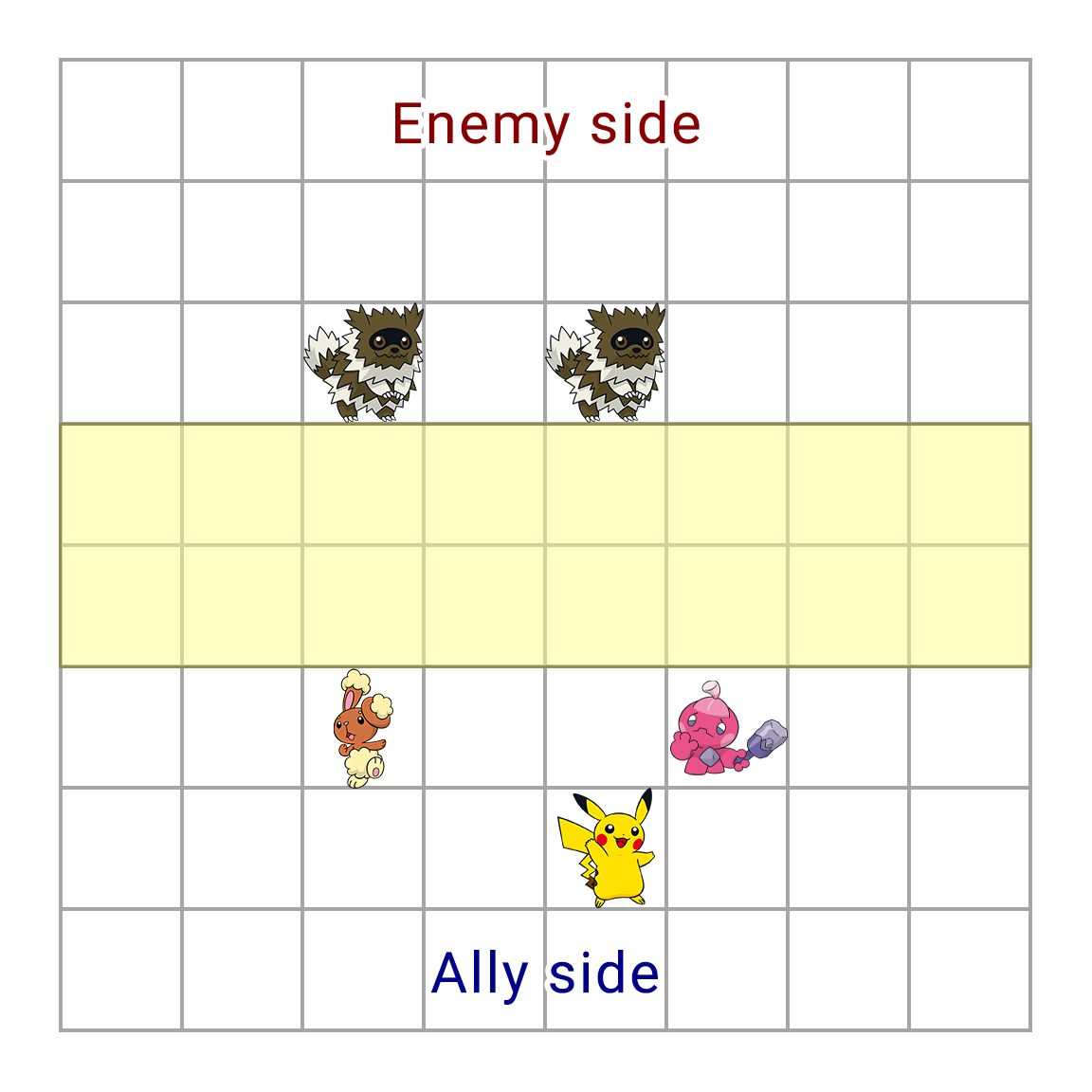 A sample starting position.
Deciding turn order
At the beginning of battle, have each player roll d10 for each of their pokemon. The GM will do the same for all enemy pokemon. (If a pokemon has a Speed bonus, roll an additional d10 for each point and choose the highest result.) The pokemon with the highest final result will move first, the second highest result will move second, and so on. Ties between a player and an enemy can be decided with a coin flip. Ties between two enemies or two allies can be resolved by consensus of the controlling players.
Keep track of the turn queue during each round to aid in remembering who moves next. Once all remaining pokemon have taken their turn, repeat the process and create a new turn queue for the next round.
When your turn comes, your pokemon can take one of the following actions:
- Move one space in any cardinal or diagonal direction (Pokemon with a Speed bonus may move additional spaces, but must move in a straight line).
- Use a move from your pokemon's move list.
- Perform a basic attack, a typeless physical move with a base power of 1 and range of 1. Does not consume PP.
- Use an item from the party's inventory.
Using moves out of turn: priority and delay
There are two ways that a pokemon can override its place in turn order:
- If a move has priority, then the user may choose to use that move at any time before their turn, even right in the middle of another pokemon's turn (i.e. right after an opponent chooses their move, but before the move is executed). Once a priority move is chosen, it cannot be interrupted by another priority move. Once it is used, the user's turn is over for that round.
- At any time before or during their turn, a pokemon may choose to delay their turn by moving to any place behind them in the queue. This can be done only once per round.
Fainting and ending combat
When a pokemon's HP drops to zero, that pokemon faints and is removed from the board. When all enemy pokemon have fainted, the battle is won and the players succeed. If all player pokemon faint, the battle is lost and the players fail.
Pokémon
Each pokemon possesses the following characteristics:
- Up to two elemental types.
- Stat bonuses characteristic of its species.
- A set of moves it can learn.
- A passive ability that modifies how the pokemon behaves in or out of combat.
Additionally, each individual pokemon has maximum HP and maximum PP that increase as the pokemon grows in level. By default, each of these start at 10.
Stat bonuses
A single stat bonus (+1) will have the following effect for each stat. These effects can stack with stat bonuses greater than +1.
- HP: Add 1 to the pokemon's maximum HP.
- Attack: Add 1 to the damage dealt by the pokemon's physical attacks.
- Defense: Decrease the damage taken from physical attacks by 1.
- Special Attack: Add 1 to the damage dealt by the pokemon's special attacks.
- Special Defense: Decrease the damage taken from special attacks by 1.
- Speed: Increase movement distance by 1. Roll 1 additional d10 and choose the highest result when determining turn order.
Moves
Pokemon moves have a variety of uses, such as executing strong attacks, weakening your enemies, or supporting your allies. The location of the user and target on the battlefield are important in determining which moves you can use.
Moves have the following general characteristics:
- Type: The user can get a damage boost by using an attack that shares its type.
- Category: Determines whether the move deals physical damage, special damage, or a status effect.
- Range: Determines how far the target can be from the user for the move to take effect.
By default, a move can only be executed in straight lines from the user's position, in all cardinal directions and diagonals. Unless otherwise specified, moves cannot "pass through" one pokemon (including allies) to hit another behind— a ranged attack will strike the pokemon closest to the user in any given line.
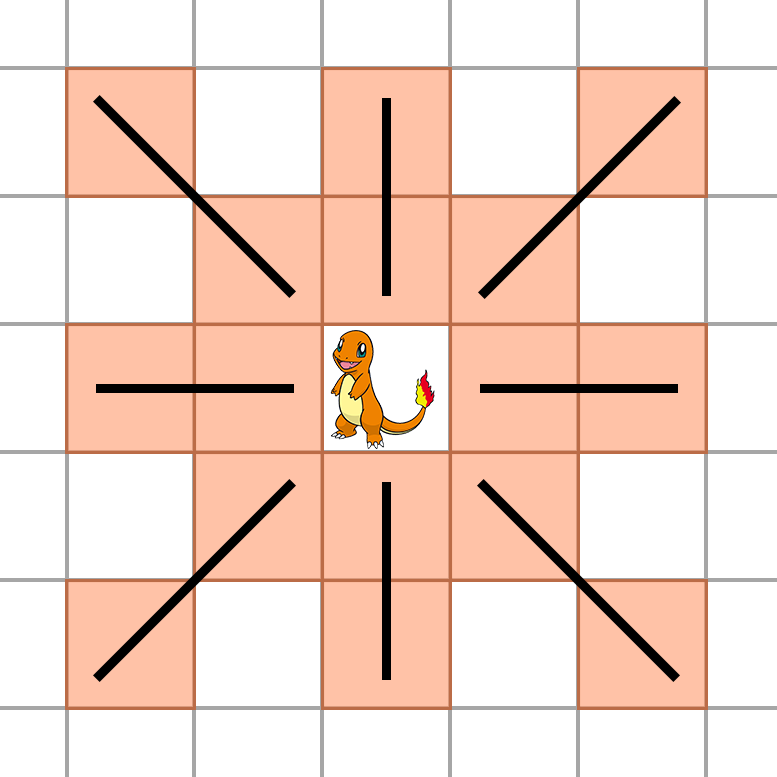 Grid squares reachable by an attack of range 2.
There are also moves that affect all pokemon in an area. This area is typically a square centered on a specific pokemon. The "range" of the square determines how far its sides extend from the center.
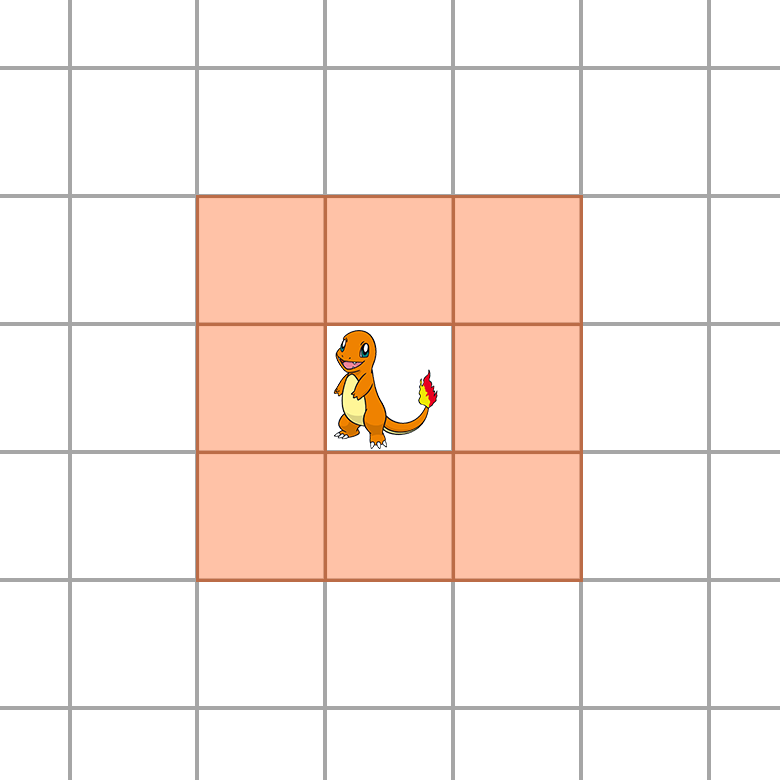
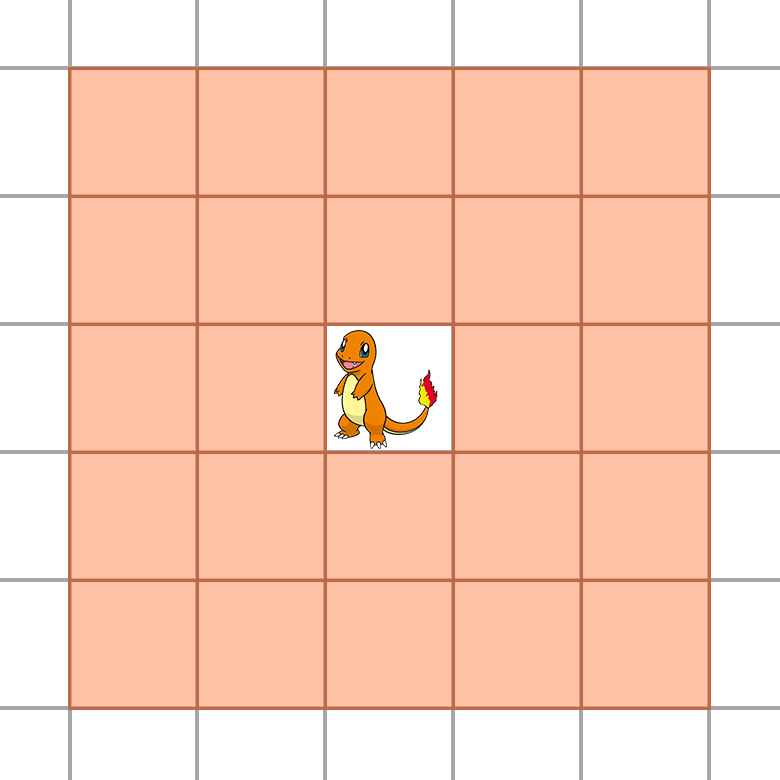 Square areas of range 1 and 2.
Calculating damage
When using a damaging attack on another pokemon, there are a number of factors that can add or subtract from the damage inflicted. Use the following list to determine the damage dealt when attacking:
- Base power: This is the foundation of a specific move's power.
- Same type attack boost (STAB): Add +1 damage if the move matches one of the user's types.
- Type advantage: Add +1 damage for each of the target's types that the move is "super effective" against. Subtract -1 damage for each of the target types that resist the move's type.
- Stat bonus: Add the user's bonus in the relevant attack stat, and subtract the target's bonus in the relevant defense stat (Physical or Special, depending on the category of the move).
- Stat modifier: Status moves used in battle may raise or lower a pokemon's offensive or defensive stats. Treat these the same as stat bonuses.
- Held items: Some held items give the user permanent stat modifiers.
- Status condition: Pokemon inflicted with the "burn" status effect have their Attack lowered by 1.
Status conditions
Pokemon may be affected by persisting status conditions in battle. These conditions may disappear on their own, or they may require moves or items to remove.
The following are considered non-volatile status conditions, meaning they persist outside of battle and cannot be stacked with each other:
- Poison: A poisoned pokemon takes 1 HP of damage after performing any action.
- Toxic poison: A variant of poison that behaves the same way, except the damage taken increases by 1 each turn.
- Burn: A burned pokemon takes 1 HP of damage after performing any action. Additionally, its attack is lowered by 1 point.
- Paralysis: A paralyzed pokemon loses all of its Speed modifiers, behaving as if it has a Speed of 0. Additionally, a paralyzed pokemon must roll d10 before its turn to determine if it can take an action. If the result is 3 or below, the pokemon will be fully paralyzed and its turn will be skipped.
- Sleep: A sleeping pokemon cannot take any action. On the first turn a pokemon is asleep, it will remain asleep. On every subsequent turn, roll d10. If the result is 8 or above, the sleep status is removed and the pokemon can perform an action. Otherwise, the pokemon remains asleep. If a pokemon stays asleep for three consecutive turns, it will be guaranteed to wake up on the next turn.
- Freeze: A frozen pokemon must roll d10 on its turn to determine if it can take an action. If the result is 8 or above, the frozen status is moved and the pokemon can perform an action. If the result is tails, the pokemon remains frozen. There is no limit to how long a pokemon can remain frozen. However, any fire-type attack will thaw both the user and the target immediately without requiring a coin flip.
The following are considered volatile status conditions, which will disappear at the end of battle. They may be applied at the same time as each other and any non-volatile status condition. Each check must be done independently.
- Confusion: A confused pokemon must roll d10 before taking its turn. If the result is 3 or below, the pokemon will perform a basic attack on itself, and damage is calculated using its own stats. Starting on the second turn that a pokemon is confused, a result of 8 or higher will remove the confusion status. If a pokemon is confused for three consecutive turns, it will snap out of confusion on the next turn.
- Attraction: An attracted pokemon must roll d10 before taking its turn. If the result is 3 or below, it will be unable to take any action. This status will persist while the pokemon responsible for inflicting the attraction is on the field.
Items
Using items can help your party survive long adventures and give you an edge in combat. Your party has a collective inventory of items that all party members can access. Any ally pokemon can use an item on itself or another ally during its turn in battle. Between battles, items can also be used or equipped to party members as held items.
Held items vs. consumables
Some items have passive effects that only work if they are held, while some items are consumed on use. If a pokemon holds a consumable item, such as a status-healing berry, it can use that item on itself at any time during battle without expending its turn. A pokemon can also choose to use its held item on an ally, but this can only be done on its turn, and is treated the same as if the item was in the party's inventory.
Items can only be equipped to party members outside of battle.
List of items
Healing items
| Name | Type | Description |
|---|---|---|
| Cheri berry | Consumable | Heals paralysis. |
| Chesto berry | Consumable | Awakens a pokemon from sleep. If held, a sleeping pokemon can use it to awaken itself. |
| Pecha berry | Consumable | Heals poison. |
| Rawst berry | Consumable | Heals burn. |
| Aspear berry | Consumable | Thaws a frozen pokemon. If held, a frozen pokemon can use it to thaw itself. |
| Leppa berry | Consumable | Restores 2 PP. |
| Oran berry | Consumable | Restores 2 HP. |
| Persim berry | Consumable | Heals confusion. If held, a confused pokemon can heal itself without a chance of hurting itself in confusion. |
| Sitrus berry | Consumable | Restores 4 HP. |
| Reviver seed | Consumable | Revives a fainted pokemon, restoring all its HP and PP. |
Throwing items
| Name | Type | Description |
|---|---|---|
| Stick | Consumable | Deals 2 HP damage to any target in a straight line. Unlimited range. Blocked by obstacles, and strikes the first target it hits. |
| Iron thorn | Consumable | Deals 4 HP damage to any target in a straight line. Unlimited range. Blocked by obstacles, and strikes the first target it hits. |
| Geo pebble | Consumable | Deals 2 HP damage to any target in a straight line. Unlimited range. Can pass over other pokemon and ignore obstacles. |
| Gravelerock | Consumable | Deals 4 HP damage to any target in a straight line. Unlimited range. Can pass over other pokemon and ignore obstacles. |
Held items
| Name | Type | Description |
|---|---|---|
| Power band | Held item | +1 Attack. |
| Defense scarf | Held item | +1 Defense. |
| Special band | Held item | +1 Special Attack. |
| Zinc band | Held item | +1 Special Defense. |
| Clear amulet | Held item | Prevents the holder's stats from being lowered by enemy attacks. |
| Pecha scarf | Held item | Prevents the user from being poisoned. |
| Persim band | Held item | Prevents the user from being confused. |
| Razor claw | Held item | Increases critical hit chance. When the holder rolls for a critical hit, allow an extra roll if the first roll fails. |
| Leftovers | Held item | Restores the holder's HP by 1 after their turn. |